Learn · Last reviewed October 31, 2026
How long can you take your eyes off the road?
About two seconds at most. NHTSA’s guidelines for in-car devices call for glances away from the road of 2 seconds or less, and 12 seconds in total for a task.[1] In NHTSA’s 100-Car study, glances away totaling more than 2 seconds at least doubled the risk of a crash or near-crash.[2] For newly licensed teens, one glance longer than 2 seconds meant 3.8 times the odds.[3]
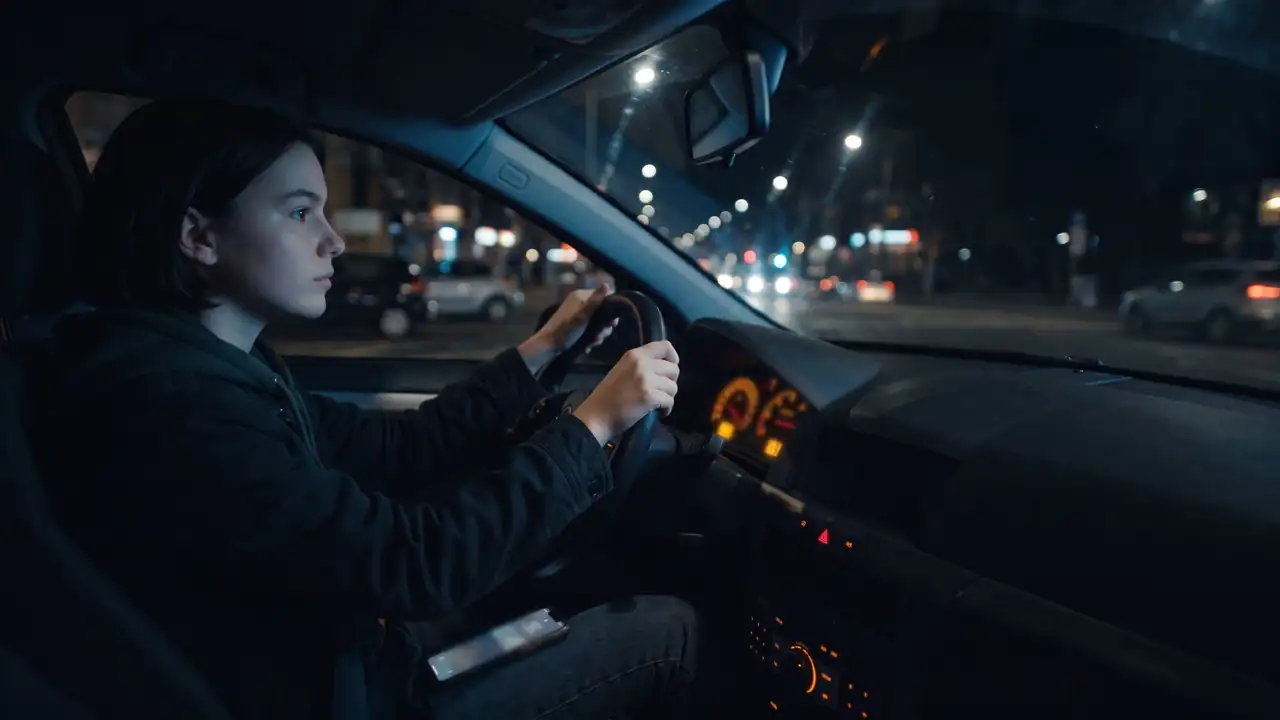
Dramatization
- 2 s
- Longest glance away from the road in NHTSA’s guidelines for in-car devices[1]
- 12 s
- Total time away for one task in the same guidelines[1]
- 2×
- At least double the crash or near-crash risk when glances away total more than 2 s[2]
- 3.8×
- The odds for new teen drivers when one glance lasts more than 2 s[3]
- 132 ft
- How far a car goes in 2 seconds at 45 mph
Where does the 2-second number come from?
From two places: guidelines NHTSA wrote for car makers, and a study of real drivers in their own cars.
NHTSA’s guidelines for in-car devices
In 2013, NHTSA, the U.S. traffic safety agency, published guidelines for screens and controls built into cars. They recommend designing each task so a driver can finish it with glances away from the road of 2 seconds or less, and 12 seconds or less in total.[1] NHTSA calls them nonbinding and voluntary: they’re design guidelines for car makers, not a traffic law.
The 100-Car study
NHTSA’s 100-Car Naturalistic Driving Study watched everyday driving in instrumented cars. Glances away from the road totaling more than 2 seconds, for any reason, at least doubled the risk of a crash or near-crash. Short glances to scan the driving environment, like a quick mirror check, were safe and actually lowered the risk.[2] So the problem isn’t looking around. It’s looking away for too long.
Are teen drivers more at risk from long glances?
Yes. New drivers are still learning what to watch, and long glances cost them more.
The teen glance study
Researchers put cameras in the cars of 42 newly licensed teenage drivers and collected data for 18 months. The risk of a crash or near-crash grew with the length of the single longest glance away from the road: when it lasted more than 2 seconds, the odds were 3.8 times higher during any secondary task, and 5.5 times higher during tasks on a wireless device, such as a phone.[3]
Teen crashes in context
Per mile driven, drivers ages 16 to 19 have a fatal crash rate almost three times that of drivers 20 and older.[4] In video of 1,691 crashes involving drivers ages 16 to 19, the AAA Foundation found the driver was inattentive or engaged in some other non-driving-related activity in 58% of crashes overall. Drivers who were operating or looking at a phone spent an average of 4.1 of the final 6 seconds before the crash looking away from the road.[5] In 2024, 3,208 people were killed in U.S. crashes where a driver was distracted.[6]
How far does a car go in 2 seconds?
At 45 mph, about 132 feet: roughly nine car lengths that nobody is watching. Multiply the speed in mph by 1.467 to get feet per second, then by the number of seconds.
| Speed | Feet per second | Distance in 2 seconds | About this many car lengths |
|---|---|---|---|
| 25 mph | 37 | 73 feet | 5 |
| 35 mph | 51 | 103 feet | 7 |
| 45 mph | 66 | 132 feet | 9 |
| 55 mph | 81 | 161 feet | 11 |
| 65 mph | 95 | 191 feet | 13 |
A car is about 15 feet long. To feel it, try this as a passenger, never as the driver: say “one thousand one, one thousand two” at a normal pace and watch how much road goes by. That’s what a driver misses in one long glance. On the home page you can pick a speed and a glance and watch the distance drawn to scale.
Is this the same as the 2-second following-distance rule?
No. Driver handbooks also teach a rule counted in seconds: how much space to leave behind the car ahead. That one is about distance, not about where your eyes are. Check your state’s driver handbook for its exact advice.
How can a new driver build a short-glance habit?
Make long glances unnecessary, then practice the rhythm until it’s automatic.
- Set up while parked. Music, navigation and messages get sorted before the car moves. Put the phone out of reach, or turn on a driving focus mode.
- Practice “glance, then back.” On supervised drives, a quick look at a mirror, a sign or the speedometer, then straight back to the road.
- Talk after the drive, not during it. A calm review at home works better than a correction at 45 mph.
- Use tools that fit your family. Some block the phone, some track the car, and some coach attention. See them compared.
How does AutoSight One use the 2-second line?
AutoSight One is a small infrared camera that faces the driver. When the eyes have been off the road for 2 seconds in one stretch, it chimes, right then. It follows the eyes, not just the head, so a look down at a phone in the lap counts even when the head still faces forward. A quick mirror check never sets it off. It works at night with its own 940 nm infrared light and keeps no video; after the drive there’s a Focus Score and a timeline of the moments that mattered. AutoSight One is a prototype and isn’t on sale yet: the first units come next, tested in parked cars before any road testing.
Reserve AutoSight One free: no payment, no commitment, founding price $129 (planned retail $149). Near Raleigh, Durham or Chapel Hill? Ask to join the pilot. You can also try the attention engine in your browser, parked or as a passenger.
Questions
Is the 2-second rule a law?
No. It comes from driving research and from NHTSA’s guidelines for how in-car devices should be designed, which NHTSA calls nonbinding and voluntary. Laws about phone use while driving vary by state.
Does checking my mirrors count as taking my eyes off the road?
A quick mirror check is part of driving. In NHTSA’s 100-Car study, short glances to scan the driving environment were safe and actually lowered crash and near-crash risk. Keep them short.
Are teen drivers more at risk from long glances?
Yes. In a study of newly licensed teens, a single glance away from the road longer than 2 seconds meant 3.8 times the odds of a crash or near-crash, and 5.5 times during tasks on a wireless device such as a phone.
How far does a car go in 2 seconds?
About 132 feet at 45 mph. Multiply the speed in mph by 1.467 to get feet per second, then by 2.
Is hands-free phone use safe?
The studies on this page measured where the eyes go, so they don’t settle that question. Keeping the eyes on the road is one part of paying attention, not all of it.
Is this the same as the 2-second following-distance rule?
No. The following-distance rule is about how much space to leave behind the car ahead. The glance guideline is about how long the eyes leave the road.
How can I tell if my teen takes long glances?
Ride along and watch, talk about it after drives, or use a coaching tool. AutoSight One is built for this; it’s a prototype and isn’t on sale yet.